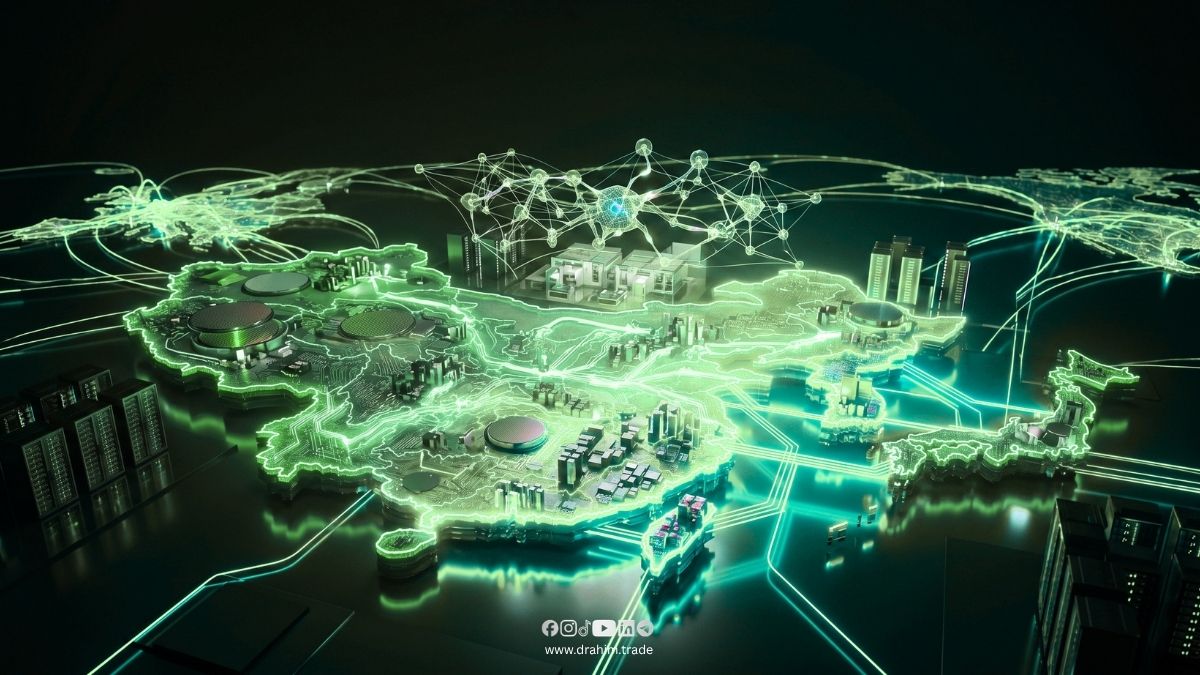
Analytical Report on the Future Prospects of Artificial Intelligence Through 2030
In recent years, the artificial intelligence (AI) sector has undergone a fundamental transformation, making it the primary driver of the new digital industrial revolution. AI has evolved from a stage of technical experimentation into a direct force shaping the global economy. Generative AI applications, cloud computing, and advanced semiconductor technologies have contributed to a global race among governments and major corporations to achieve technological leadership.
First: Latest Developments in Artificial Intelligence and the Technology Sector
The year 2025 witnessed an unprecedented investment boom in artificial intelligence. Companies such as Microsoft, Amazon, Meta, and Google announced investments exceeding $320 billion in AI infrastructure and data centers.
Meanwhile, Open AI strengthened its position as the leading startup in the sector, supported by more than $13 billion in investments from Microsoft, while its market valuation rose dramatically. Likewise, Nvidia became one of the largest beneficiaries of this expansion due to the growing global demand for advanced graphics processing units (GPUs) used to train intelligent models.
These figures reflect the high level of investor confidence in AI, which is increasingly viewed as the foundational infrastructure of the future digital economy.
This optimism is driven by several factors, most notably:
- Rapid progress in large language models and generative AI systems.
- Increasing institutional adoption of AI tools.
- Higher productivity and lower operational costs.
- Geopolitical competition between the United States and China for technological leadership.
Second: Factors Influencing Demand and Industrial Challenges
The growing demand for AI is linked to several factors, especially the increasing need for automation, big data analysis, and faster decision-making across sectors such as healthcare, finance, education, and manufacturing.
However, this growth faces complex industrial challenges, most importantly semiconductor shortages and the rising energy costs required to operate massive data centers. Studies indicate that AI supercomputers consume enormous amounts of electricity, and energy demand may double annually through 2030.
The industry also depends heavily on sensitive raw materials, such as rare earth minerals used in semiconductor manufacturing, creating risks associated with global supply chains and geopolitical tensions.
The sector’s major weaknesses include:
- High operational and training costs.
- Excessive dependence on a limited number of dominant companies.
- Risks of financial valuation bubbles among some startups.
Significant ethical concerns have also emerged, including:
- Violations of privacy and personal data protection.
- Algorithmic bias and discrimination.
- The spread of misinformation and deepfakes.
- The displacement of traditional jobs due to automation.
Third: Economic Analysis
Artificial intelligence has become part of everyday life through smart assistants, translation services, recommendation systems, autonomous vehicles, and digital healthcare. This has improved efficiency while reducing time and costs across many economic activities.
Economically, the rapid development of AI has reshaped the global economy through:
- Increased spending on digital infrastructure.
- Rising valuations of technology companies and AI-related stocks.
- A labor market shift toward technical and analytical jobs.
- Enhanced productivity in manufacturing and service industries.
AI has also contributed to the creation of a new data-driven and cloud-based economy, alongside the growing importance of cybersecurity and digital energy infrastructure. At the same time, concerns have emerged regarding the widening economic gap between developed and developing nations due to unequal technological capabilities.
Fourth: Future Expectations Between 2026 and 2030
1. Optimistic Scenario (50% Probability)
The technology sector continues its strong growth as AI adoption expands across industries, leading to higher productivity and economic returns. This scenario depends on sustained investment flows and improvements in energy and semiconductor infrastructure.
2. Moderate Scenario (35% Probability)
The sector achieves stable but slower growth due to rising costs and stricter government regulations. Major corporations continue to dominate the market, while some startups with unsustainable business models decline.
3. Pessimistic Scenario (15% Probability)
An investment bubble emerges, resulting in a sharp decline in AI company valuations due to weak financial returns compared to massive spending levels, in addition to energy crises and supply chain disruptions.
Conclusions and Recommendations
Artificial intelligence is expected to remain the primary engine of economic and technological growth over the next decade. However, the success of this transformation depends on achieving a balance between innovation and both economic and ethical sustainability.
Key recommendations include:
- Expanding investment in digital education and technical skills.
- Developing regulations that govern AI usage and protect privacy.
- Diversifying supply chains and reducing dependence on limited suppliers.
- Supporting sustainable energy infrastructure and data centers.
- Encouraging the responsible use of AI to achieve balanced economic development.